Too Hard
Famed investor Warren Buffett has a filtering mechanism when looking at investment opportunities. He separates opportunities into three boxes: “In,” “Out,” and “Too Hard”. When assessing complex, volatile, or misunderstood businesses, he famously places them in the “too hard” file, prioritizing his “circle of competence” over chasing difficult, risky, or uncertain investments. With the growing conflict in the Middle East others might guess on the geopolitical outcome, here at Cypress we focus on what is knowable rather than speculating. We have seen a dramatic rise in the price of oil which has at least temporarily reversed the weaker dollar trend, interest rate cut expectations and many of the equity themes that had been working last year and in the first two months of 2026.
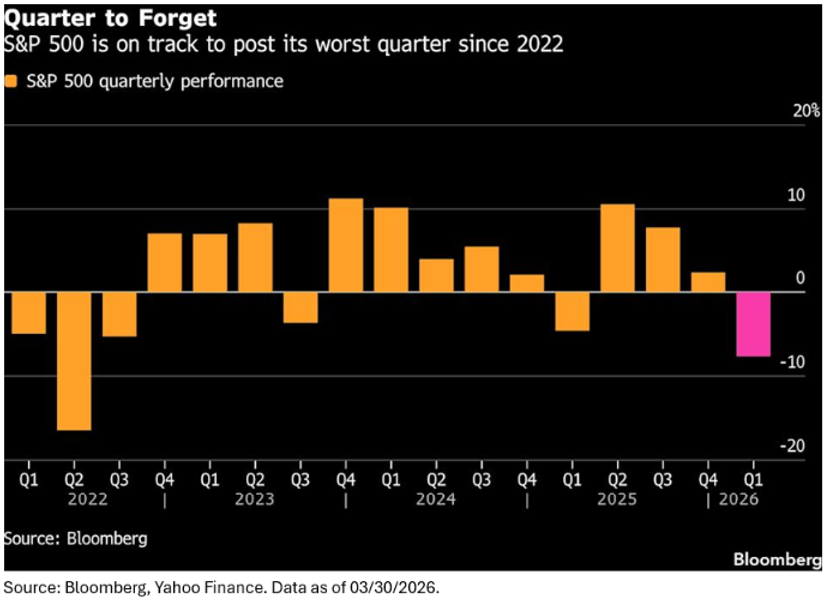
Since the beginning of military action in February the markets have experienced wild fluctuations in asset prices that in many cases are reversed in short order. For the quarter the S&P 500 was down 4.63% as concerns about how much the economy would slow as a result of higher oil prices (1). Many sectors of the equity market performed even worse than the S&P 500, namely Financials, Consumer Discretionary and Technology were each down over 9% for the year (2).
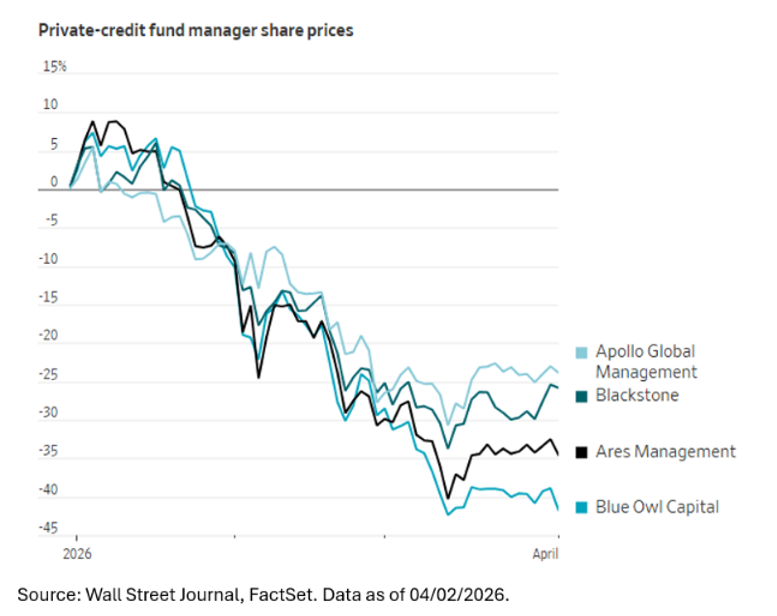
Although the headlines were consumed by the goings on across the globe there was one issue that received scant attention, that being the “liquidity mismatch” that many investors in the Private Investment sector are realizing. With each passing day it seems that yet another one of these funds has had to restrict their clients’ requests to access their investments. Fortunately for all our clients at Cypress Bank & Trust, we have not and will not invest our clients’ portfolios in investments that not only restrict liquidity and lack transparency, but many times create the need for delayed tax reporting. At Cypress, we always put our clients’ interests ahead of our own and do not create any proprietary investment vehicles that might compromise our fiduciary position with our clients.
Regarding the long-term impacts of the conflict in the Middle East, due to the number of variables that have yet to be defined it is difficult to discern a concrete thesis on how events will totally unfold. That being said it is entirely plausible that once the conflict is resolved we might experience higher levels of long-term interest rates and price of oil along with slower economic growth than was forecast before the conflict began. As always, your team at Cypress is diligently at the helm as we try to navigate these turbulent waters and attempt to mitigate the impacts of these uncertain events while keeping each of our clients’ bespoke circumstances as our North Star.
The U.S. equity market wrapped up a volatile first quarter of 2026 with its weakest performance since 2022, despite a sharp rebound on the final trading day. Markets came under pressure beginning in late February as escalating geopolitical tensions in the Middle East drove oil prices significantly higher, reviving inflation concerns and weighing on investor sentiment.
Performance across the major indexes reflected this volatility. The Nasdaq Composite was the most impacted, declining 7.1% for the quarter and briefly entering correction territory as higher yields weighed on technology and growth-oriented stocks. The S&P 500 finished the quarter down 4.6%, with late-March weakness erasing earlier gains despite still-solid underlying fundamentals. The Dow Jones Industrial Average held up relatively better, down 3.6% for the quarter, and rallied more than 1,100 points on the final day amid signs of diplomatic progress tied to the Iran conflict (3).
Beneath the surface, market leadership remained highly concentrated. Energy was the clear standout, up roughly 38% year-to-date as supply disruptions pushed oil prices above $100 per barrel (4). In contrast, large-cap technology and AI-related stocks pulled back meaningfully as investors reassessed valuations and the pace of expected returns on heavy capital spending. Financials were the weakest-performing sector, pressured by concerns around lending standards and private credit exposure.
From a broader economic standpoint, the Federal Reserve continued its “wait-and-see” approach as inflation remained sticky, leading markets to price in fewer rate cuts for 2026.
Consumer trends also remained uneven, with higher-income households continuing to spend, while lower-income consumers showed increasing strain, reflected in rising auto and credit card delinquencies.
Fixed Income
The bond market got off to a choppier start in 2026 as expectations for continued rate cuts gave way to a more cautious, “wait-and-see” approach from the Federal Reserve. After easing policy late last year, the Fed opted to pause in the first quarter as inflation proved more persistent and global tensions picked up.
Treasury yields were especially volatile. Both short- and long-term rates rose as investors adjusted to the idea that additional rate cuts may take longer to materialize. The 10-year Treasury ended the quarter around 4.31%, while the 2-year yield climbed even more as optimism around near-term easing faded (5). The yield curve continues to gradually steepen, and the intermediate segment of the curve has been an area of focus for investors looking to balance income and risk.
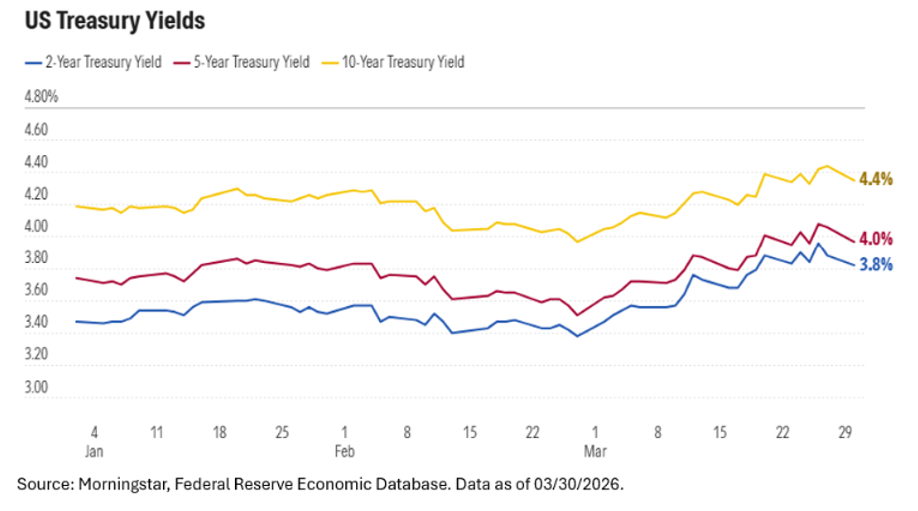
Looking ahead, fixed income continues to play an important role in portfolios, especially in periods of uncertainty and market volatility. We remain focused on thoughtful positioning across the bond market, aiming to generate consistent income while managing interest-rate risk as the economic and policy backdrop continues to evolve.
Outlook
The first quarter of 2026 proved to be a turbulent and challenging period for global financial markets. U.S. equities faced a difficult three-month stretch, driven by a combination of escalating tariff anxieties, renewed skepticism around AI valuations, and mounting concerns in private credit markets — resulting in the S&P 500 closing the quarter down roughly 4%, its weakest quarterly performance since Q3 2022 (6). Technology stocks were hit particularly hard, with U.S. software stocks declining sharply through late February as investors grew concerned that new AI capabilities could threaten the software-as-a-service model and questioned whether hyperscaler’s could justify ever-increasing AI capital expenditures. Meanwhile, a major outbreak of conflict in the Middle East rattled global sentiment, driving Brent oil prices up by 63% in March alone — the largest single-month surge in four decades — and effectively disrupting the critical Strait of Hormuz.
Against this backdrop, commodities emerged as the standout asset class. The Bloomberg Commodity Index was the top performer of the quarter, rising over 24%, as energy and grain prices surged in response to the geopolitical shock. The energy sector led all S&P 500 sectors, gaining 38% in Q1 and standing as the only sector to post positive returns in March (7). Fixed income offered little shelter, as government bond markets sold off sharply across the globe, with hopes for central bank rate cuts giving way to fears of stagflation — prompting markets to shift from pricing in cuts at the Fed and ECB to pricing in potential rate hikes.
Credit spreads widened in both high yield and investment grade markets, while a stronger U.S. dollar and elevated geopolitical risk weighed on emerging market debt. The remainder of 2026 is shaping up to be a market environment defined by cautious optimism, with several key forces in play. Goldman Sachs expects sturdy global growth of around 2.8%, with the U.S. likely to outperform on the back of reduced tariff drag, tax cuts, and easier financial conditions — though that optimism comes with caveats (8). Markets have already priced in a lot of anticipated good news, including Fed rate cuts, stimulus from fiscal legislation, and the belief that AI adoption will dramatically boost corporate profitability, leaving limited room for additional upside surprises. On the rates front, Morgan Stanley expects government bond yields to stay range-bound in a tale of two halves — a front-loaded rally as the Fed cuts rates pushing 10-year yields lower by mid-year, before drifting higher into Q4, with the dollar following a similar arc (9). AI remains the dominant market theme, spreading beyond tech into banking, healthcare, logistics, and utilities, and anchoring the bullish case for U.S. equities — though elevated valuations mean any signs of AI skepticism could trigger episodes of volatility. Wells Fargo cautions that tariff impacts may slow the economy and nudge inflation higher in the near term, before positive policy and technology spending trends reverse those conditions toward year-end, with yield and credit quality remaining the key metrics to watch. Overall, the consensus leans constructive but acknowledges a narrow margin for error — investors who stay diversified and agile are best positioned to navigate what promises to be a nuanced second half of the year.
Always vigilant, our commitment to you is to navigate your portfolio through both calm and turbulent times to work towards your long-term goals and objectives.
References:
(1) FactSet; data as of 03/31/2026.
(2) FactSet, Fidelity Sector Performance; data as of 03/31/2026.
(3) FactSet; data as of 03/31/2026.
(4) Cnbc.com, Fidelity Sector Performance; data as of 03/31/2026.
(5) Cnbc.com, FactSet; data as of 03/31/2026.
(6) FactSet, data as of 03/31/2026.
(7) FactSet, Fidelity Sector Performance; data as of 03/31/2026.
(8) Goldman Sachs; data as of December of 2025.
(9) CME Group FedWatch, data as of 03/31/2026.
Disclosures
Trust and Portfolio Management services offered by Cypress Bank & Trust are not insured by the FDIC; are not deposits, are not guaranteed; and are subject to investment risks, including possible loss. This does not constitute an offer or solicitation.
This information should not be considered investment advice. Opinions expressed reflect the judgment of the authors and are current opinions as of the date appearing in this material only. While every effort has been made to verify the information contained herein, we make no representations as to its accuracy and it should not be regarded as a complete analysis of the subjects discussed. Past performance does not predict future results. Content should not be construed as legal or tax advice. Always consult an attorney or tax professional regarding your specific legal or tax situation. All investing involves risk, including the loss of some or all of your investment.
Any indices and other financial benchmarks shown are provided for illustrative purposes only, are unmanaged, reflect reinvestment of income and dividends and do not reflect the impact of advisory fees. Investors cannot invest directly in an index. Comparisons to indexes have limitations because indexes have volatility and other material characteristics that may differ from a particular fund.
Certain information contained herein constitutes “forward-looking statements,” which can be identified by the use of forward-looking terminology such as “may,” “will,” “should,” “expect,” “anticipate,” “project,” “estimate,” “intend,” “continue,” or “believe,” or the negatives thereof or other variations thereon or comparable terminology. Due to various risks and uncertainties, actual events, results or actual performance may differ materially from those reflected or contemplated in such forward-looking statements.
Nothing contained herein may be relied upon as a guarantee, promise, assurance or a representation as to the future.
Information obtained from third party sources is believed to be reliable but has not been independently verified and its accuracy or completeness cannot be guaranteed. No representation is made with respect to the accuracy, completeness, or timeliness of this document.
Specific investments described herein do not represent all investment decisions made by Cypress Bank & Trust. The reader should not assume that investment decisions identified and discussed were or will be profitable. Specific investment advice references provided herein are for illustrative purposes only and are not necessarily representative of investments that will be made in the future.