Happy 250th Birthday!
As America celebrates the anniversary of our Declaration of Independence, it is a timely reminder that while the American experiment remains marvelous, we still live in a world filled with geopolitical turmoil and challenges. Throughout the second quarter, the conflict in the Middle East continued to dominate the headlines, with shifting dynamics bringing new developments almost daily.
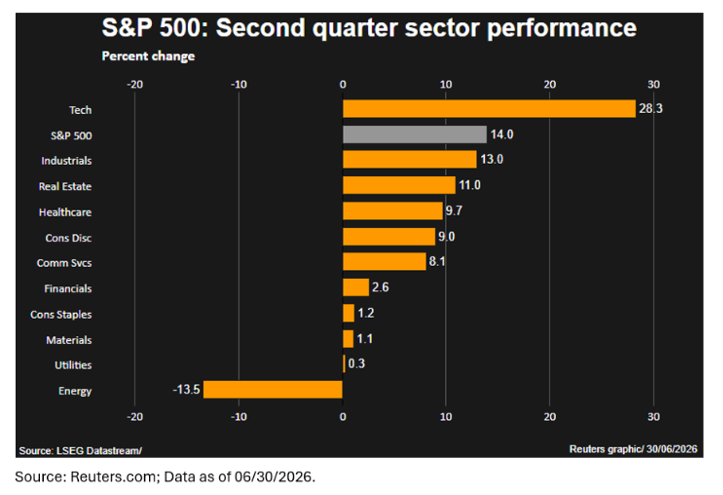
Typically, this type of global uncertainty triggers a negative reaction from the stock market. This quarter, however, we witnessed the exact opposite. The S&P 500 Index rose by 14.87% in the second quarter, marking its best quarterly return since Q2 of 2020 (1). Led primarily by semiconductor and chip stocks, with the PHLX Semiconductor Sector Index (SOX) surging 87.8%, the market largely brushed aside fluctuating oil prices and a more hawkish tone from the Federal Reserve regarding interest rates (2).
While it is easy to get caught up in the euphoria of a dramatic market rally or the latest investment fad, our approach remains steadfast. At Cypress Bank & Trust, your team seeks to construct your portfolio based on your specific goals and risk tolerance. This approach is intended to position your portfolio to pursue strong returns within a risk level you are comfortable taking.
Our investment process is rooted in sound fundamentals with the goal of helping clients navigate market turbulence. We believe our experience has taught us that chasing “hot” stocks or short-term trends rarely gives our clients the highest probability of achieving their long-term financial goals.
Equities
Equity markets continued to push higher during the quarter despite several headwinds, including elevated interest rates, ongoing geopolitical tensions, and concerns about whether corporate earnings can maintain their current pace of growth. The fact that stocks were able to advance in that environment highlights the market’s confidence in longer-term growth opportunities, particularly in areas such as artificial intelligence, automation, and other technologies that have the potential to improve productivity and drive future earnings.
Within the indices that describe the market the S&P 500 gained 14.9%, Dow Industrial Index gained 12.9%, and Nasdaq rose 21.4% (3). As we stand, the equity market continues to be heavily influenced by a relatively small group of large-cap technology and AI-related companies.
Outside of mega-cap technology, there are still opportunities, but they require a more selective approach. Valuation dispersion remains wide across sectors, market capitalizations, and geographies. Certain areas of the market still look expensive, while others have been largely ignored. This creates an opportunity for active management and thoughtful portfolio construction. Companies with strong balance sheets, durable cash flows, pricing power, and reasonable valuations should be better positioned if economic growth slows or if interest rates remain elevated.
Fixed Income
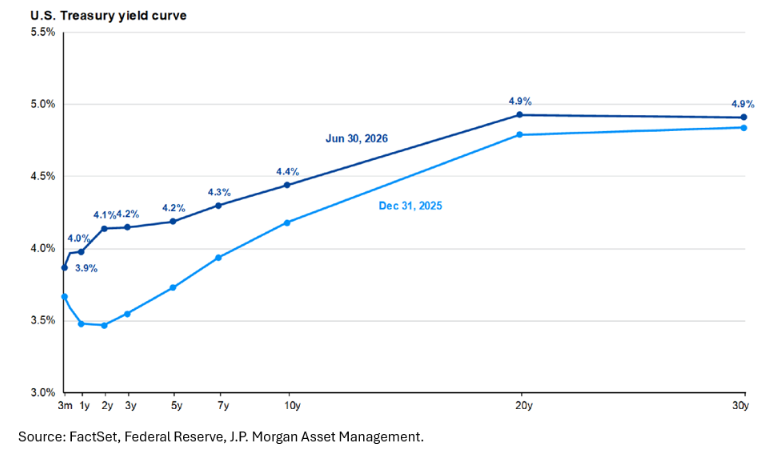
Longer-term Treasury yields moved higher during the second quarter as markets reassessed inflation, fiscal policy, and the future path of Federal Reserve policy. The peak of the 10-year Treasury yield during Q2 2026 was 4.69% with the 30-year yield hitting its highest level in 19 years at 5.2% (4).
The Federal Reserve remains in a difficult position. If it cuts rates too quickly, it risks reigniting inflation pressures. If it keeps policy restrictive for too long, it risks slowing the economy more than intended. For bond investors, this means the path of interest rates may remain choppy, especially as each inflation report and labor market release influences expectations for Fed policy.
Credit markets have also remained relatively resilient, but spreads are still tight in many areas. In our view, this is not the time to stretch too far for yield. High-quality bonds look attractive, but lower-quality credit requires more caution.
Overall, while recognizing that bond values may fluctuate, we continue to view fixed income as an important source of income and diversification.
Outlook
As we look toward the second half of 2026, we remain cautiously optimistic about financial markets despite an environment marked by geopolitical uncertainty, evolving trade relationships, and continued questions surrounding monetary policy. The resilience displayed by equity markets during the first half of the year suggests investors’ confidence in the underlying strength of the U.S. economy and corporate America. While market leadership has been concentrated in technology and artificial intelligence-related companies (5), we believe the next phase of the market may broaden beyond a handful of mega-cap stocks as earnings growth expands across additional sectors. Volatility should be expected, particularly as investors react to developments in the Middle East, fiscal policy debates, and ongoing economic data releases, but periods of uncertainty can create opportunities for disciplined long-term investors.
Within equities, valuations in certain segments of the market have become elevated following the strong rally, particularly among some AI and semiconductor-related companies. As a result, future returns may become more dependent on earnings growth rather than expanding valuation multiples. We believe a selective approach remains essential, favoring companies with strong balance sheets, sustainable competitive advantages, and consistent free cash flow generation. Opportunities continue to exist in areas of the market that have lagged the technology-driven advance, including select industrial, healthcare, financial, and dividend-oriented companies. Maintaining diversification across sectors, market capitalizations, and geographies remains an important component of risk management in an environment where market leadership could shift quickly.
In fixed income, higher interest rates have restored attractive income opportunities that have been absent for much of the past decade. While the Federal Reserve may continue to face challenges balancing inflation concerns with economic growth, current bond yields provide investors with meaningful income and potential portfolio stability. We continue to favor high-quality bonds and believe they may serve as an effective diversifier should economic growth moderate or market volatility increase. Overall, our investment outlook remains grounded in the belief that long-term success is achieved not by attempting to predict short-term market movements, but by maintaining a disciplined, diversified investment strategy aligned with each client’s unique goals, risk tolerance, and time horizon.
Always vigilant, our commitment to you is to navigate your portfolio through both calm and turbulent times to work towards your long-term goals and objectives.
References:
(1) FactSet Research Systems; data as of 06/30/2026.
(2) FactSet Research Systems; data as of 06/30/2026.
(3) FactSet Research Systems; data as of 06/30/2026.
(4) Cnbc.com, & CNN Business; data as of 06/30/2026.
(5) FactSet Research Systems; data as of 06/30/2026.
Disclosures
Trust and Portfolio Management services offered by Cypress Bank & Trust are not insured by the FDIC; are not deposits, are not guaranteed; and are subject to investment risks, including possible loss. This does not constitute an offer or solicitation.
This information should not be considered investment advice. Opinions expressed reflect the judgment of the authors and are current opinions as of the date appearing in this material only. While every effort has been made to verify the information contained herein, we make no representations as to its accuracy and it should not be regarded as a complete analysis of the subjects discussed. Past performance does not predict future results. Content should not be construed as legal or tax advice. Always consult an attorney or tax professional regarding your specific legal or tax situation. All investing involves risk, including the loss of some or all of your investment.
Any indices and other financial benchmarks shown are provided for illustrative purposes only, are unmanaged, reflect reinvestment of income and dividends and do not reflect the impact of advisory fees. Investors cannot invest directly in an index. Comparisons to indexes have limitations because indexes have volatility and other material characteristics that may differ from a particular fund.
Certain information contained herein constitutes “forward-looking statements,” which can be identified by the use of forward-looking terminology such as “may,” “will,” “should,” “expect,” “anticipate,” “project,” “estimate,” “intend,” “continue,” or “believe,” or the negatives thereof or other variations thereon or comparable terminology. Due to various risks and uncertainties, actual events, results or actual performance may differ materially from those reflected or contemplated in such forward-looking statements. Nothing contained herein may be relied upon as a guarantee, promise, assurance or a representation as to the future.
Information obtained from third party sources is believed to be reliable but has not been independently verified and its accuracy or completeness cannot be guaranteed. No representation is made with respect to the accuracy, completeness, or timeliness of this document.
Specific investments described herein do not represent all investment decisions made by Cypress Bank & Trust. The reader should not assume that investment decisions identified and discussed were or will be profitable. Specific investment advice references provided herein are for illustrative purposes only and are not necessarily representative of investments that will be made in the future.