Cypress News

Businessman writing notes during meeting.
Benefits of Generational Wealth Transfers for Florida Residents

Florida continues to be one of the most attractive states for building, preserving, and transferring wealth. In addition to its favorable climate and quality of life, Florida offers significant legal and tax advantages that can benefit families planning for future generations.

Florida residents enjoy the benefit of no state income tax, inheritance tax, or estate tax. These advantages can help families preserve more wealth and create opportunities for effective estate planning. Through strategic gifting, trust planning, and proper asset titling, families can transfer assets efficiently while helping to minimize taxes and administrative burdens.

Lifetime gifting remains an effective tool for transferring wealth. Annual exclusion gifts allow individuals and married couples to pass assets to children, grandchildren, and other beneficiaries during their lifetimes. Gifts may include cash, securities, or other assets and can help reduce the size of a taxable estate.

Trusts are another valuable planning tool. Properly structured trusts can provide asset protection, professional management, privacy, and long-term control over how wealth is distributed to future generations. In addition, beneficiary designations and appropriate account titling can allow certain assets to transfer outside of probate.

Florida also offers strong creditor protections, including homestead protections for primary residences as well as protections for certain life insurance policies, annuities, and retirement accounts. These safeguards can help preserve family wealth and provide financial security for loved ones.

Whether funding education through college savings plans, transferring investment assets, or establishing trusts for future generations, a thoughtful estate plan can help ensure that your family’s values and financial legacy endure for years to come.

At Cypress Bank & Trust, we work closely with clients, families, attorneys, and tax advisors to develop personalized wealth transfer strategies. Whether serving as Trustee, Successor Trustee, or Personal Representative, our goal is to help families protect, preserve, and transfer wealth with confidence.

For more information about estate and trust planning administration, please visit Cypress Bank & Trust or contact one of our trust professionals.

Trust and Portfolio Management services offered by Cypress Bank & Trust are not insured by the FDIC or any federal government agency, are not deposits or other obligations of, or guaranteed by, the Bank or any bank affiliate, and are subject to investment risks, including the possible loss of principal.

This article is for informational purposes only and should not be considered legal, tax, or financial advice. Please consult your attorney, accountant, or financial advisor regarding your specific circumstances.

Can a Corporate Trustee Help Keep the Peace?

Family dynamics can complicate even the most thoughtfully prepared estate plan. Second marriages, blended families, caregiving responsibilities, differing financial circumstances, and expectations around inheritances can create tension, especially when decisions need to be made about distributions, investments, or property.

A corporate trustee can provide objectivity, continuity, and professional oversight. Instead of placing a family member in the difficult position of balancing fiduciary responsibilities with personal relationships, an independent trustee follows the terms of the trust while handling administration, investment management, recordkeeping, tax reporting, and beneficiary communications.

Perhaps most importantly, an impartial trustee can help separate financial decisions from family emotions. The goal is not only to preserve the intent of your estate plan, but also the family relationships behind it.

If you’re considering who should serve as trustee, talk with your estate planning advisor or the Cypress team about whether a corporate trustee may be right for your family.

Framed black-and-white photograph of boats on a misty shore
Why the Right Banking Relationship Matters for Small Businesses

For a small business, choosing the right financial partner can be as important as choosing the right customers or employees. A trusted banking relationship provides access to capital, cash-flow solutions, strategic guidance, and financial expertise that help businesses navigate challenges and seize growth opportunities. The right partner also brings consistency, responsiveness, and a long-term perspective that supports decision-making as businesses evolve.

As a Commercial Banking Associate, my goal is to understand each client’s unique needs and priorities, building meaningful relationships that go beyond transactions. I focus on delivering thoughtful, customized solutions that support both day-to-day operations and long-term success, helping clients feel confident in every stage of their growth. If you’re in the Maitland area, please feel free to stop by. I’d welcome the opportunity to learn about your business and discuss how I can help support your goals and growth.

Business professionals shake hands during a meeting.
A Client-First Approach Starts with Curiosity, Not Conclusions

In today’s increasingly complex financial landscape, the most valuable investment professionals don’t just provide answers, they ask better questions. The kind that uncovers what truly matters, challenge assumptions, and evolve alongside your life. Because thoughtful financial planning isn’t a one-time event, it’s an ongoing dialogue. As markets shift and personal circumstances change, the questions and the strategy should adapt in step. At Cypress Bank & Trust, this philosophy is central to how we serve clients, rooting every relationship in a deeper understanding of individual goals, evolving needs, and long-term priorities.

That ongoing dialogue is what naturally leads to the role of a true fiduciary. At Cypress, we are both legally and ethically obligated to act solely in a client’s best interest with no competing incentives, no hidden agendas. In an industry where recommendations can still be influenced by sales-driven models, that distinction matters more than ever. It ensures that every question we ask and every strategy we develop remains fully aligned with the people we serve, reinforcing a transparent, objective, and client-first approach at every step.

At its core, effective wealth management isn’t about products or quick answers. It’s about curiosity, discipline, and partnership that is rooted in trust, transparency, and a deep understanding of where you are today and where you want to go next.

Man in suit chats while holding a drink
A Community Bank That Knows Your Story

As someone who was born and raised in this community, I know how important it is to have a community bank you can trust, one that truly understands and supports you.

Choosing a bank is a big decision. It should be someone who takes the time to get to know you, listens carefully, and truly cares about what you are trying to build. The right bank is not just a place to keep your money. It is a relationship that helps make everyday decisions easier and your long-term goals more achievable.

When your bank understands your story, whether that means growing your business, continuing the family legacy, and making plans that affect those closest to you the guidance you receive becomes more meaningful.
Conversations feel thoughtful instead of generic. Advice is tailored, not transactional. That kind of partnership leads to better decisions, stronger planning, and fewer surprises along the way.

A bank rooted in the community is personally invested in seeing its clients succeed, because when you thrive, so do the places we all call home. Add to that approachable bankers who answer the phone, know your name, and take the time to explain options clearly, and the experience feels fundamentally different.

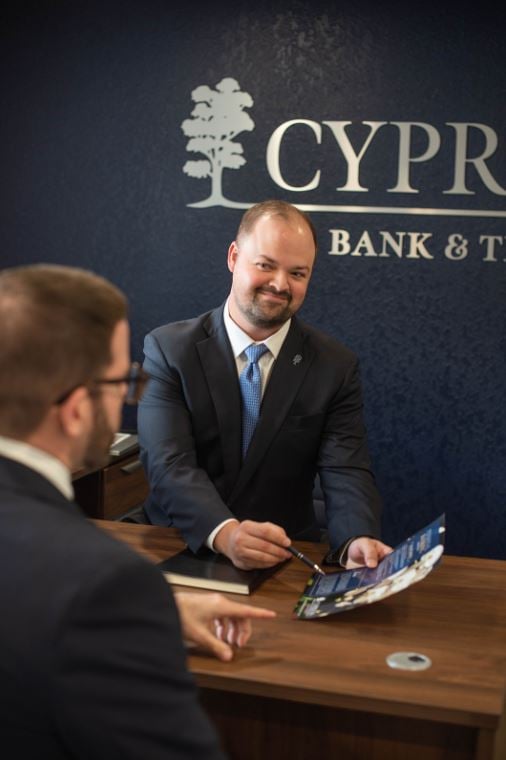
Bank representative discusses brochure with client at desk
Trusted Advisors. Stronger Business.

Every small business benefits from building a trusted team of advisors who provide expertise, perspective, and support at every stage of growth. Surround yourself with professionals who understand your industry and are invested in your success. An attorney can help establish the right legal structure, a CPA can provide sound financial guidance and accounting expertise, a banker can support your growth and financing needs, and an insurance professional can help protect what you have worked so hard to build.

The right advisory team does more than offer services—they help you make informed decisions, avoid costly mistakes, navigate challenges, and seize new opportunities with confidence. As your business evolves, these trusted relationships become an essential part of your long-term success.

No business owner achieves success alone. Success is built through hard work, strong partnerships, trusted guidance, and the right people standing beside you every step of the way. I would be delighted to help connect you with experienced professionals who can support your goals, strengthen your foundation, and position your business for sustainable growth and long-term success.

At Cypress Bank Maitland Office we are ready and eager to assist you through every step. Call us or stop by!

Is Your Business Prepared for the Unexpected?

Success isn’t just about growing your business. It’s also about protecting everything you’ve worked so hard to build.

No matter how successful a company may be, unexpected challenges can arise. Economic uncertainty, market disruptions, health concerns, or the loss of a key employee can quickly impact operations and long-term plans.

The real question isn’t whether challenges will occur. It’s whether you’re prepared when they do.

At Cypress Bank & Trust, we believe meaningful banking relationships go beyond loans and deposits. We help business owners think through the difficult questions, identify potential risks, and create plans that strengthen their businesses for the future.

Ask yourself: Is your banker having these conversations with you?

We’re committed to investing in people, businesses, and communities by helping our clients build resilience, protect their success, and prepare for whatever comes next.

Businessman writing notes during meeting.
Estate Planning Through All Stages of Life

“Life is what happens when you’re making other plans.”– JOHN LENNON

This rings true no matter what stage of life. If we’ve learned anything during this COVID-19 era, it is that it’s impossible to predict and control the future. Life just happens. Circumstances change, priorities evolve, and unexpected events can arise when we least expect them. While we can’t predict the future, we can prepare for it.

Your crystal ball is likely as good as the next guy’s, which is why it is important to have documents in place to ensure your wishes are known and your loved ones are protected while navigating life as it happens.

Just as importantly, estate planning is not only about deciding what happens to your assets—it is also about deciding who will carry out your wishes. A well-drafted estate plan is only as effective as the people or institutions entrusted to implement it. A thoughtfully designed plan can provide peace of mind knowing the right people, or institutions, are in place when they are needed most.

With that said, you may think estate planning doesn’t apply to you: you aren’t old enough or you don’t have an “estate” or significant assets… so there’s nothing to plan. Well, if you’re over the age of 18, please think again.

IN YOUR 20’s:

Once you turn 18, your parents no longer have authority to make health or financial decisions for you. Advance Directives are a set of important documents that you should have regardless of your financial circumstances.

ADVANCE DIRECTIVES

POWER OF ATTORNEY: This document delegates authority to an “agent” to handle financial matters on your behalf. The functions that your agent can perform may be general or specific depending on how much authority you wish to grant to your agent.

HEALTH CARE SURROGATE DESIGNATION: A Health Care Surrogate is an individual who you specifically grant the ability to make medical decisions on your behalf. This document is only used in the unfortunate event you are unable to make your own health care decisions. If you are able to communicate your wishes to your health care providers, the Health Care Surrogate Designation is not used.

LIVING WILL: Unlike a Last Will and Testament, a Living Will is effective while you are alive. It is a legal document that spells out medical treatments you would and would not want to be used to keep you alive, as well as your preferences for other medical decisions, such as pain management or organ donation.

Why are these important?

In sum, the pragmatic answer to this question is: peace of mind. In the unfortunate event you are deemed unable to make financial or medical decisions, but a decision must be made, these documents will come into play to reflect your wishes and designate who will make these decisions on your behalf. Advance Directives avoid the need for a guardianship, save time and money, and ensure the person you would trust to make these decisions knows your wishes and is able to serve in that role.

By way of example, let’s follow Sue: She is a 26-year-old driving home from work. She gets in a car accident and is taken to the hospital. A myriad of situations can arise. Worst case scenario, Sue cannot make medical decisions for herself because complications occur and she’s not able to consent to a procedure.

If she did not designate a Health Care Surrogate, family members may disagree about how her doctor should proceed. Sue may also have wished that her longtime significant other, who works in the medical field, make the decisions. This does not only delays decision-making, but also detracts from the possibility of her actual wishes being carried out.

IN YOUR 30’s:

Personal and financial circumstances typically shift in your 30s. You may own a home, may have gotten married, started a family and grown your assets. To make sure your spouse, children and assets are protected, it is an important time to discuss with an attorney which legal strategies to employ to best serve your goals.

LAST WILL AND TESTAMENT (“Will”): A Will directs upon your death who will inherit your assets, who will be in charge of settling your estate and, if necessary, who will care for your children if you and your spouse are unable to.

TRUST: A Trust transfers ownership of your assets to someone you choose (called the trustee, who in many cases may be you) and dictates who will manage your assets for the beneficiaries you designate. Trusts can hold different kinds of assets, such as real estate and investment accounts. Trusts can also be set up in many different ways. You may have heard of Living Trusts, Revocable Trusts or Irrevocable Trusts.

Why are these important?

Peace of mind that your loved ones will be taken care of after your passing and ensure your hard-earned assets will be managed in accordance with your wishes.

Sue made a full recovery and is now 33 years old, married, and a proud mother of her one-year-old son, Jimmy. She wants to make sure Jimmy is taken care of in the event she and her husband are not able to care for him. Sue would like to designate her brother and sister-in-law as Jimmy’s legal guardians in the unfortunate event that she and her husband are unable to care for him.

What happens if a Last Will and Testament or Trust is not prepared?

If Jimmy receives an inheritance because both Sue and her husband have predeceased him, a minor guardianship will need to be established for Jimmy who has not yet reached age 18.

A minor guardianship is a court process that appoints individual(s) to have legal authority and a duty to care for a minor’s person and/or property (this may be the same person). Without a Will in place stating who Sue would like to assume these roles, it is up to the court process to decide who would be Jimmy’s legal guardian(s) in this unfortunate situation.

How can a Will or Trust help?

Sue can nominate her brother and sister-in-law in her Will to serve as Jimmy’s guardians and provide for his custody and care if she and her husband are unable to do so. If Sue establishes a trust for Jimmy, she can avoid the need for a minor guardianship over his inheritance while providing a framework for how and when assets will be managed and distributed for his benefit. She must also decide who will serve as trustee and carry out those responsibilities. Serving as trustee involves significant fiduciary duties, including investment oversight, tax reporting, recordkeeping, and making distributions in accordance with the terms of the trust.

IN YOUR 40’s:

If the above documents are in place – congratulations! It may be a good time to review them to make sure they are still current. If not, it’s important to catch up.

Sue and her husband are now in their 40’s. Their assets have grown, and they decided to update their existing documents. Sue would like to make a charitable donation to the hospital that helped her in her 20’s.

Sue also remembers what it was like to be 18 years old and thinks it’s a good idea for Jimmy’s inheritance to be held and protected in a trust, with her brother serving as trustee and managing the assets for Jimmy’s benefit. Sue would like the trust to assist Jimmy as he navigates his 20’s. The trust instructs the trustee to make disbursements to help pay for Jimmy’s schooling, rent, medical bills, etc., while giving her brother (as trustee) authorization to make these disbursements at his discretion. The remaining trust assets will be distributed, in their entirety, to Jimmy when he turns 30 years old, ending the trust.

As Sue’s estate grows, she begins to think about the long-term administration of the trust. While her brother is willing to serve as trustee today, she recognizes that circumstances can change. He may relocate, become unable to serve, or simply no longer wish to assume the responsibilities associated with trust administration.

To provide continuity, Sue discusses naming a corporate trustee as either trustee or successor trustee. A corporate trustee can provide professional administration, objective decision-making, and ongoing oversight while carrying out the instructions outlined in her trust.

IN YOUR 50’s and 60’s:

At this juncture, your familial, personal and financial realm has likely expanded. This is a critical time to get documents in place, if you have not already, as well as a good time to review and update existing documents.

Sue’s son, Jimmy, is now a legal adult, and her new goal is to avoid probate. She contacts her estate planning attorney to discuss what she can do proactively to make the transfer of her assets at her passing as simple a process as possible for her loved ones who survive her.

As part of that planning, she also considers a corporate trustee to help relieve family members of the responsibilities associated with trust administration, investment management, tax reporting, and beneficiary communications.

IN YOUR 70’s AND BEYOND:

At this stage, with your estate plan complete, the focus should be on reviewing and updating your documents as appropriate.

This is also an appropriate time to confirm that the individuals or institutions named in your documents remain willing and able to serve in their designated roles.

In sum, life happens, and circumstances (like Sue’s) change throughout the years. Having documents in place provides clarity to loved ones, ease of carrying out your wishes and peace of mind that even though “life is what happens when you’re making other plans,” you have your plan and are prepared for the life that happens.

Thoughtful planning includes not only deciding what should happen, but also choosing who will be responsible for carrying out those wishes when the time comes.

WHEN DOES A CORPORATE TRUSTEE MAKE SENSE?

Depending on a family’s circumstances and goals, choosing the right trustee can be just as important as creating the trust itself.. A corporate trustee may be worth considering if:

  • You do not have a family member or friend who is willing or able to serve as trustee.
  • You want professional investment management and trust administration.
  • Your trust is intended to last for many years or generations.
  • You have concerns about potential conflict among family members or beneficiaries.
  • You would prefer an impartial fiduciary to make discretionary distribution decisions.
  • Your estate includes complex assets, significant wealth, or charitable planning objectives.
  • You want continuity and stability, regardless of changes in individual circumstances.
  • You wish to relieve loved ones of the administrative responsibilities that come with serving as trustee.

A corporate trustee serves as a fiduciary, meaning it is legally obligated to act in the best interests of the beneficiaries and administer the trust according to its terms. Unlike an individual trustee, a corporate trustee does not retire, relocate, become incapacitated, or pass away.

For many families, the decision is not whether a loved one is trustworthy—it is whether they should bear the responsibility. In the right circumstances, a corporate trustee can provide experience, objectivity, and continuity while allowing family members to remain family.


Calculator and charts on office desk
How Financially Independent Are You? Take the Quiz

Financial independence means different things to different people. For some, it’s having enough savings for peace of mind. For others, it’s reducing debt, preparing for retirement, or simply feeling more confident about everyday finances.

Take this quick quiz from Cypress Bank & Trust to see how financially independent you may be and where there may be opportunities to strengthen your financial future.

1. Do You Have an Emergency Fund?

  • A. Yes, enough to cover several months of expenses
  • B. I’m working on it
  • C. Not yet

2. Are You Able to Pay Your Bills on Time Each Month?

  • A. Consistently
  • B. Most of the time
  • C. Sometimes it’s difficult

3. Are You Regularly Contributing to Savings or Retirement Accounts?

  • A. Yes, consistently
  • B. Occasionally
  • C. Not currently

4. How Comfortable Do You Feel With Your Current Debt Levels?

  • A. Very manageable
  • B. Somewhat manageable
  • C. Stressful or overwhelming

5. Do You Follow a Monthly Budget or Spending Plan?

  • A. Yes
  • B. Sometimes
  • C. No

6. Could You Handle an Unexpected Expense Without Relying on Credit?

  • A. Yes
  • B. Possibly
  • C. Probably not

7. Do You Have Clear Financial Goals for the Future?

  • A. Yes
  • B. A few general ideas
  • C. Not yet

Your Results

Mostly A’s

You’re building strong financial habits and taking positive steps toward financial independence. Continue reviewing your goals regularly and staying consistent with savings and planning.

Mostly B’s

You’re making progress, but there may be opportunities to strengthen your financial foundation. Small adjustments now can help improve long-term financial confidence.

Mostly C’s

Every financial journey starts somewhere. Focusing on small, manageable goals — like building savings or creating a simple budget — can help you move toward greater financial stability over time.

Financial Independence Is a Journey

Financial confidence doesn’t happen all at once. It’s built through thoughtful planning, consistent habits, and informed decisions.

At Cypress Bank & Trust, we’re committed to helping clients build a strong financial future with tools, guidance, and personalized support along the way.

Storm damage by lakeside with palm trees and debris.
Hurricane Prep List
Hurricane preparedness checklist by Cypress Bank & Trust.

Preparing for hurricane season goes beyond stocking up on water and batteries. It’s also about protecting your financial well-being. From securing important documents to reviewing your insurance coverage and ensuring access to emergency funds, every step plays a role in keeping you prepared and resilient.

We’ve put together a straightforward disaster preparedness checklist to help you feel confident before a storm is even on the radar. It’s designed to give you peace of mind, knowing you’ve covered not just the basics, but the financial essentials too.

Download your copy and stay prepared for whatever this season brings: Hurricane Checklist

Businessman writing notes during meeting.

Benefits of Generational Wealth Transfers for Florida Residents

Can a Corporate Trustee Help Keep the Peace?

Framed black-and-white photograph of boats on a misty shore

Why the Right Banking Relationship Matters for Small Businesses

Business professionals shake hands during a meeting.

A Client-First Approach Starts with Curiosity, Not Conclusions

Man in suit chats while holding a drink

A Community Bank That Knows Your Story

Bank representative discusses brochure with client at desk

Trusted Advisors. Stronger Business.

Is Your Business Prepared for the Unexpected?

Businessman writing notes during meeting.

Estate Planning Through All Stages of Life

Calculator and charts on office desk

How Financially Independent Are You? Take the Quiz

Storm damage by lakeside with palm trees and debris.

Hurricane Prep List

Professionals discussing in modern office kitchen.

Introduction to Trusts

Two people discussing documents at a counter.

Reflect. Refocus. Renew: Planning for 2026 and Beyond

Espresso hour sign beside plant on table.

Florida’s Small Businesses: The Heartbeat of a Thriving Economy

Person typing on keyboard, holding mouse

Smart Tax Planning: Why October is the Perfect Time to Prepare

Framed black-and-white photograph of swamp with orchids

The Extraordinary Power of Compounding: A Lesson from Einstein and Everyday Life

Fluffy brown dog resting on a couch

Protecting Your Pets When You Can’t Be There

Cypress Bank & Trust employees smiling during a ribbon-cutting ceremony for the Vero Beach office.

Vero Beach Ribbon Cutting & Holiday Kickoff Celebration!

Person using smartphone outdoors, close-up view.

More information on new cloud-based software system!

Smiling man at desk with laptop

Cypress set to transition to a new cloud-based trust accounting software system!

Businessman writing notes during meeting.

A Memo to My Younger Self

Newsletter

Stay connected and discover how Cypress Bank & Trust can be your partner in achieving your financial goals.

KEEP IN TOUCH

Sign Up
Scroll to Top
Florida Trend 2026 Best Companies Winner badge

Named Florida's #1 Best Company to Work For